Every successful business decision starts with financial visibility.
Without clear financial information, business owners are forced to make decisions based on instinct, bank balance, sales activity, or incomplete reports. That may work for a short time, but it becomes dangerous as the business grows.
Financial visibility means leadership can see the true financial position of the business in a clear, timely, and useful way.
It is not just about having accounts. It is about understanding what those accounts mean.
What Financial Visibility Includes
Clear financial visibility usually includes accurate bookkeeping, reconciled bank accounts, management reports, cash flow tracking, margin analysis, receivables aging, payables visibility, tax liabilities, and key performance indicators.
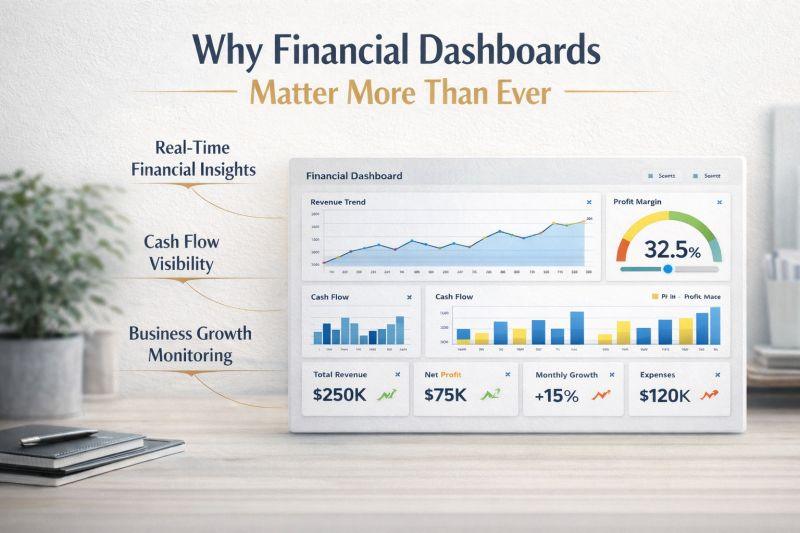
A proper financial dashboard or reporting pack should help leadership answer practical questions:
Are we profitable? Are margins improving or weakening? Do we have enough cash for the next 30 to 90 days? Which customers owe us money? Which costs are increasing? Are we meeting budget? Which parts of the business need attention?
If leadership cannot answer these questions quickly, the business does not have enough financial visibility.
Why Bank Balance Is Not Visibility
Many business owners use the bank balance as their main financial indicator.
That is risky.
The bank balance only shows cash available today. It does not show future payroll, tax payments, supplier obligations, debt repayments, delayed customer collections, or upcoming project costs.
A business may look cash-positive today and still face pressure next month.
This is why cash flow reporting and forecasting are essential. They allow management to see what is coming, not only what has already happened.
Visibility Improves Decision-Making
Good financial visibility changes how decisions are made.
Hiring decisions become more controlled because leadership can see payroll impact. Pricing decisions become stronger because margins are visible. Expansion decisions become more disciplined because cash flow can be forecast. Cost reduction decisions become smarter because management can identify where money is actually going.
Without visibility, businesses often cut the wrong costs, underprice services, delay important investments, or expand before they are financially ready.
With visibility, decisions become more deliberate.
The Role of KPIs
Key performance indicators help convert financial data into management insight.
Useful KPIs may include gross margin, net profit margin, cash conversion cycle, debtor days, revenue per employee, operating expense ratio, project profitability, budget variance, and recurring revenue trends.
The right KPIs depend on the business model.
A service business may need utilization and margin reporting. A construction business may need project cost tracking. A retailer may need inventory and gross margin visibility. A professional firm may need receivables, payroll cost, and client profitability tracking.
Generic reporting is not enough. The reporting must match the business.
Why Growing Businesses Lose Visibility
As businesses grow, financial visibility often gets worse before it gets better.
More transactions, more staff, more suppliers, more tools, and more customer activity create complexity. If finance systems do not improve, reporting becomes slower and less reliable.
This is why growing businesses need structured financial systems, reporting processes, and advisory review.
Growth without visibility creates risk.
A Better Approach
Businesses should build a monthly reporting rhythm.
This includes regular bookkeeping, bank reconciliations, debtor and creditor review, cash flow forecasting, KPI dashboards, tax provision tracking, and management commentary.
The report should not be overloaded. It should be clear enough for leadership to act.
Final Thought
You cannot improve what you cannot see.
Clear financial visibility gives business owners control over cash, costs, profitability, and growth decisions. It turns finance from a recordkeeping function into a decision-making tool.
For businesses that want stronger control, financial advisory support can help design dashboards, reporting packs, and KPI systems that make financial performance easier to understand and manage.