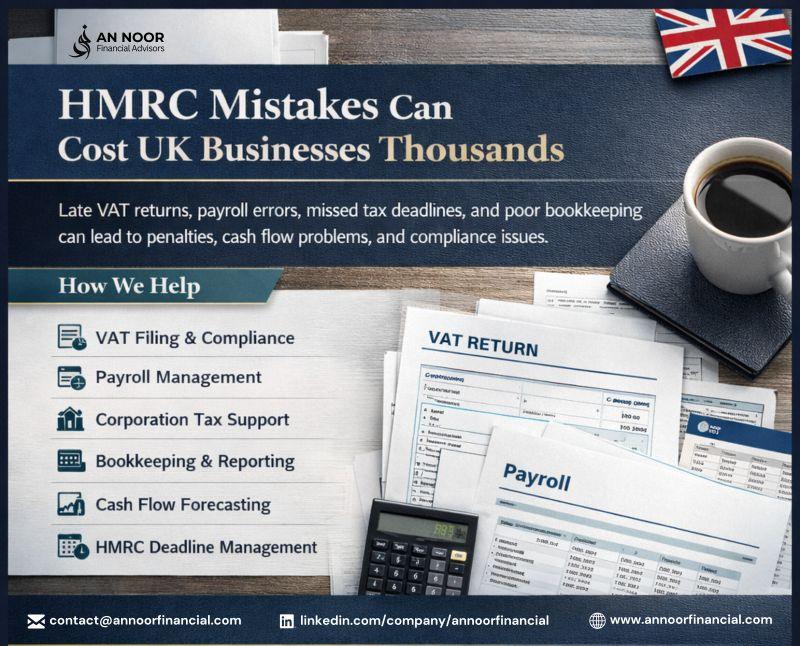
UK HMRC compliance is becoming more demanding for growing businesses.
For many SME owners, the problem is not that they ignore tax responsibilities. The problem is that compliance becomes harder as the business grows. More sales, more staff, more supplier activity, more VAT transactions, more payroll records, and more reporting deadlines create operational pressure.
If the finance process is not structured, HMRC compliance can quickly become reactive.
Why UK HMRC Compliance Matters
HMRC compliance is not only about submitting forms on time. It depends on the quality of the financial records behind those submissions.
VAT returns need accurate sales and purchase records. Payroll submissions require correct employee data and salary calculations. Corporation Tax depends on reliable bookkeeping, reconciliations, expense classification, and year-end adjustments.
If the underlying records are weak, the filing becomes risky.
A business may file on time and still face problems later if the numbers are inaccurate, unsupported, or inconsistent.
Common Compliance Issues for UK SMEs
Many UK businesses struggle with the same issues.
VAT returns are prepared from incomplete records. Payroll becomes more complex as teams grow. Corporation Tax planning is delayed until the year-end. Directors do not have clear visibility over tax liabilities. Bookkeeping is updated irregularly. Multiple spreadsheets create confusion. Important deadlines are missed because nobody owns the compliance calendar.
These issues are not always obvious at first. But over time, they increase the risk of penalties, cash flow pressure, and management distraction.
The VAT Challenge
VAT compliance requires disciplined recordkeeping.
Businesses need to correctly capture output VAT, input VAT, exempt or zero-rated supplies where relevant, supplier invoices, credit notes, and adjustments. Mistakes in VAT coding or missing documents can lead to incorrect returns.
For businesses operating with high transaction volume, e-commerce sales, construction activity, professional services, or cross-border trade, VAT becomes even more sensitive.
Regular review is essential.
Payroll and PAYE Accuracy
Payroll is another area where mistakes become expensive.
Incorrect employee data, missed PAYE submissions, wrong pension treatment, weak salary records, or delayed payroll processing can create compliance problems and employee trust issues.
As headcount grows, payroll should not remain a manual afterthought. It needs clear processes, review controls, and proper documentation.
This is where payroll support and outsourced finance operations can reduce risk.
Corporation Tax Planning
Corporation Tax should not be reviewed only when the filing deadline is close.
Businesses need periodic review of profitability, allowable expenses, director transactions, fixed assets, accruals, provisions, and tax estimates. This gives management a clearer view of expected liability and helps avoid last-minute cash surprises.
Good Corporation Tax support starts months before filing.
The Role of Bookkeeping
Accurate bookkeeping is the foundation of HMRC compliance.
If transactions are not recorded properly, reconciliations are delayed, or expenses are misclassified, every downstream compliance task becomes weaker.
Clean books allow VAT returns, payroll reporting, Corporation Tax calculations, and management accounts to be prepared with greater confidence.
A Better Compliance Model
UK businesses should build a compliance rhythm.
That means monthly bookkeeping, regular bank reconciliations, VAT review, payroll review, Corporation Tax planning, compliance calendar management, and clear reporting to directors.
This is not unnecessary bureaucracy. It is basic financial control.
Final Thought
HMRC compliance is not a once-a-year task. It is an ongoing finance operation.
Businesses that stay organized, maintain accurate records, and review obligations regularly reduce penalties, improve cash flow planning, and operate with more confidence.
For UK SMEs, structured tax advisory, bookkeeping, payroll, and reporting support can turn HMRC compliance from a recurring stress point into a controlled business process.